From GTA Missions to Python Coding: Why Gaming Logic is the Secret Weapon for Engineering Students
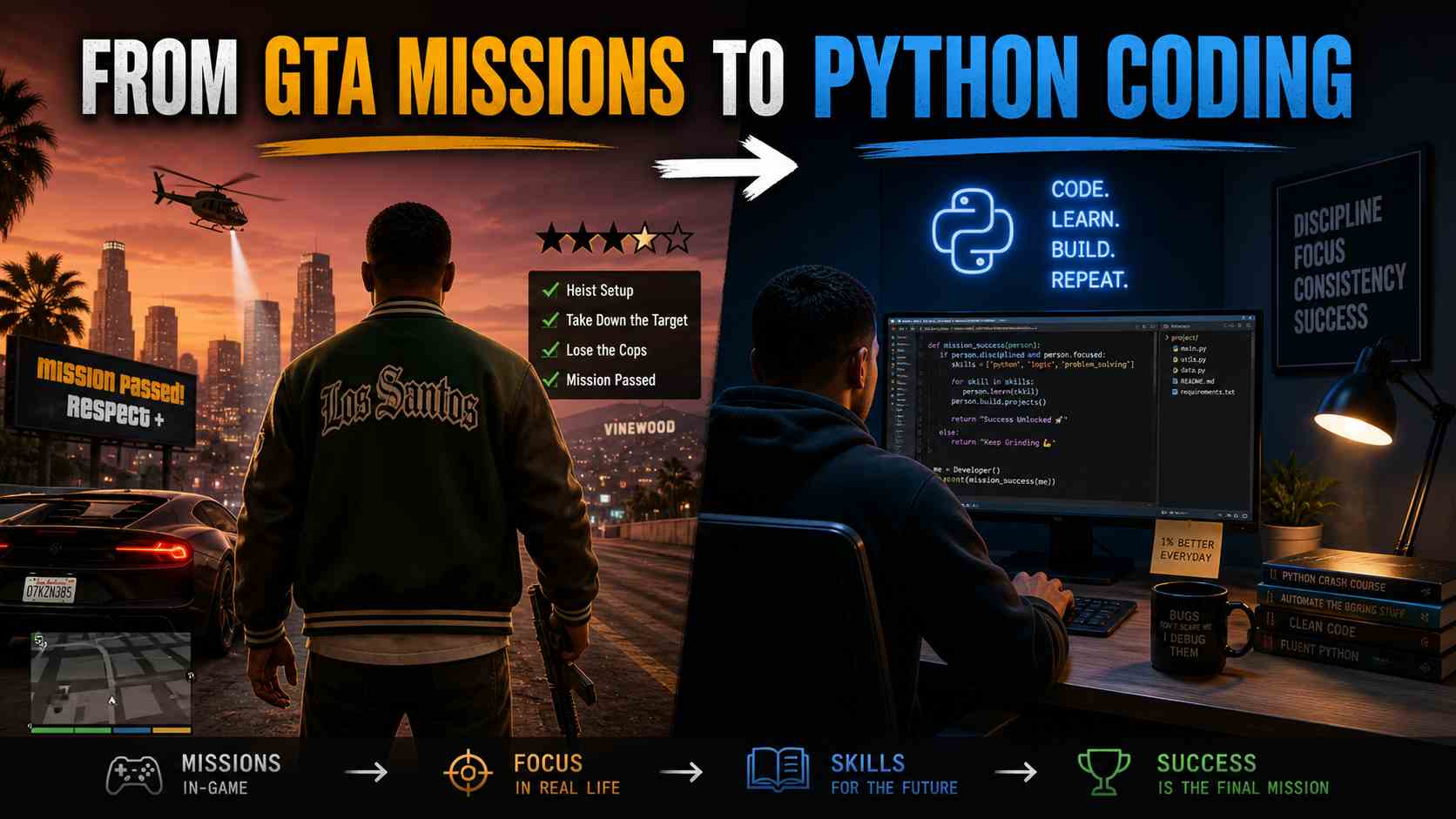
The roar of an engine in Los Santos and the silent execution of a Python script might seem worlds apart. One involves high-speed chases and chaotic missions, while the other requires sitting in a quiet room staring at lines of code. However, if you look under the hood, the engine driving both is exactly the same. For engineering students, the hours spent navigating complex game worlds are not wasted time. In fact, those gaming sessions are stealthy training grounds for the most critical skill in modern engineering: algorithmic thinking.
The Mechanics of Logic: Why Gamers Are Natural Coders
When you play a game, you are constantly processing “if-then” scenarios. If the police are chasing you in a mission, then you need to find a fast car or a clever hiding spot. This is the exact foundation of programming. Python, one of the most popular languages for engineers, relies heavily on these conditional statements.
Engineering isn’t just about memorizing formulas. It is about understanding how different parts of a system interact. In a game, you learn the meta—the rules that govern the world. You figure out which weapons work best against certain enemies or how to optimize your character’s stats. This is systems thinking. When an engineering student moves from a controller to a keyboard, they already possess a brain wired to find the most efficient path to a goal.
Breaking Down the Mission: Modular Thinking
In many open-world games, a massive mission is actually a series of smaller, manageable tasks. You might have to steal a vehicle, lose the heat, and then reach a specific coordinates point. This is a direct parallel to how we write code. A complex program is just a collection of small functions working together.
Engineering students often feel overwhelmed by massive projects. However, gamers are used to the grind. They know that to reach the final boss, they must complete the side quests first. This modular approach is why gamers often find it easier to debug a script. If a program crashes, they don’t panic. They look at it like a failed mission: what went wrong, where was the mistake, and how can the strategy be adjusted for the next attempt?
The C++ Connection: Where Performance Meets Precision
While Python is great for data science and quick scripts, many engineering disciplines require a deeper dive into how hardware functions. This is where C and C++ come into play. These languages are the backbone of most high-end game engines. If you want to understand how a car’s onboard computer processes sensor data in real-time, you need to understand low-level programming.
Many students struggle when the curriculum shifts from high-level logic to manual memory management. It requires a level of precision that can be exhausting. If you find yourself stuck on a complex pointer problem or a memory leak, it is perfectly fine to ask a professional to do my c homework so you can focus on the broader architectural concepts of your project. This allows you to maintain your momentum without getting bogged down by the syntax “boss fights” that often stall progress.
Algorithmic Strategy in Sports and Simulations
The connection between gaming and engineering extends into sports simulations too. Games like Cricket 07 or FIFA require an understanding of probability and physics. You aren’t just pressing buttons; you are calculating the trajectory of a ball or the stamina of a player.
Engineering students use these same principles when building simulations for structural integrity or fluid dynamics. The ability to visualize a 3D space and predict how objects will move within it is a gift developed through years of gaming. Whether you are aiming for a perfect cover drive or designing a bridge, the spatial awareness remains the same.
Why Programming Homework Feels Like a High-Stakes Quest
There is a specific kind of frustration that comes with a “Syntax Error.” It feels very much like a “Mission Failed” screen popping up right before you reach a checkpoint. For an engineering student, the pressure to perform is immense. You are expected to master math, physics, and several different coding languages all at once.
Sometimes, the difficulty spike in a semester is higher than a Dark Souls boss. When the workload becomes a barrier to actually learning the concepts, getting expert help with programming homework is a smart tactical move. It is the equivalent of using a walkthrough or a strategy guide. It doesn’t mean you aren’t doing the work; it means you are using your resources to ensure you cross the finish line with a passing grade.
The Evolution of the Engineering Mindset
The 2026 engineering landscape is shifting. We are no longer just building physical things; we are building “digital twins” of the world. AI and machine learning are integrated into every branch of the field. This requires a mindset that is comfortable with trial and error.
Gamers are uniquely suited for this because they aren’t afraid of failing. In a game, death is just a chance to restart with more knowledge. In engineering, a failed simulation is just a data point. This resilience is the secret weapon. While others might get discouraged by a bug in their Python code, a gamer sees it as a puzzle waiting to be solved.
Bridging the Gap: From Entertainment to Career
If you are an engineering student who feels guilty about spending time on your PC or console, stop. You are developing the very skills that will make you a top-tier developer or systems designer. You are learning how to:
- Identify patterns in complex data.
- Optimize workflows for better performance.
- Stay calm under pressure during “crunch time.”
- Work in teams to achieve a common objective.
The transition from GTA missions to Python coding is more of a lateral move than a vertical climb. You are simply applying your existing logic to a different interface. Instead of a virtual city, you are navigating a virtual database. Instead of a getaway car, you are driving a data pipeline.
Conclusion
The most successful engineers are those who can think outside the box. By embracing the logic found in gaming, you give yourself a massive advantage over those who only study textbooks. You understand that every problem has a solution, every system has a vulnerability, and every complex task can be broken down into simple steps.
Keep playing, keep curious, and keep coding. The skills you sharpen in the virtual world are the very ones that will build the future of the real one.